
What Is Local SEO? A Plain-English Guide
Local SEO is the work of getting a business found by people searching nearby, in the map results Google shows above everything else. It is a different job from ordinary SEO, it is decided by different signals, and most of the work happens somewhere that is not your website.
That last part is why so many owners get nowhere. They pay for a website, wait, and never appear on the map, because the map barely reads their website at all.
Where local results actually appear
Search for anything with local intent, a plumber, a dentist, coffee, and Google does not give you ten blue links. It gives you a map with three businesses pinned to it, and the ordinary results start underneath.
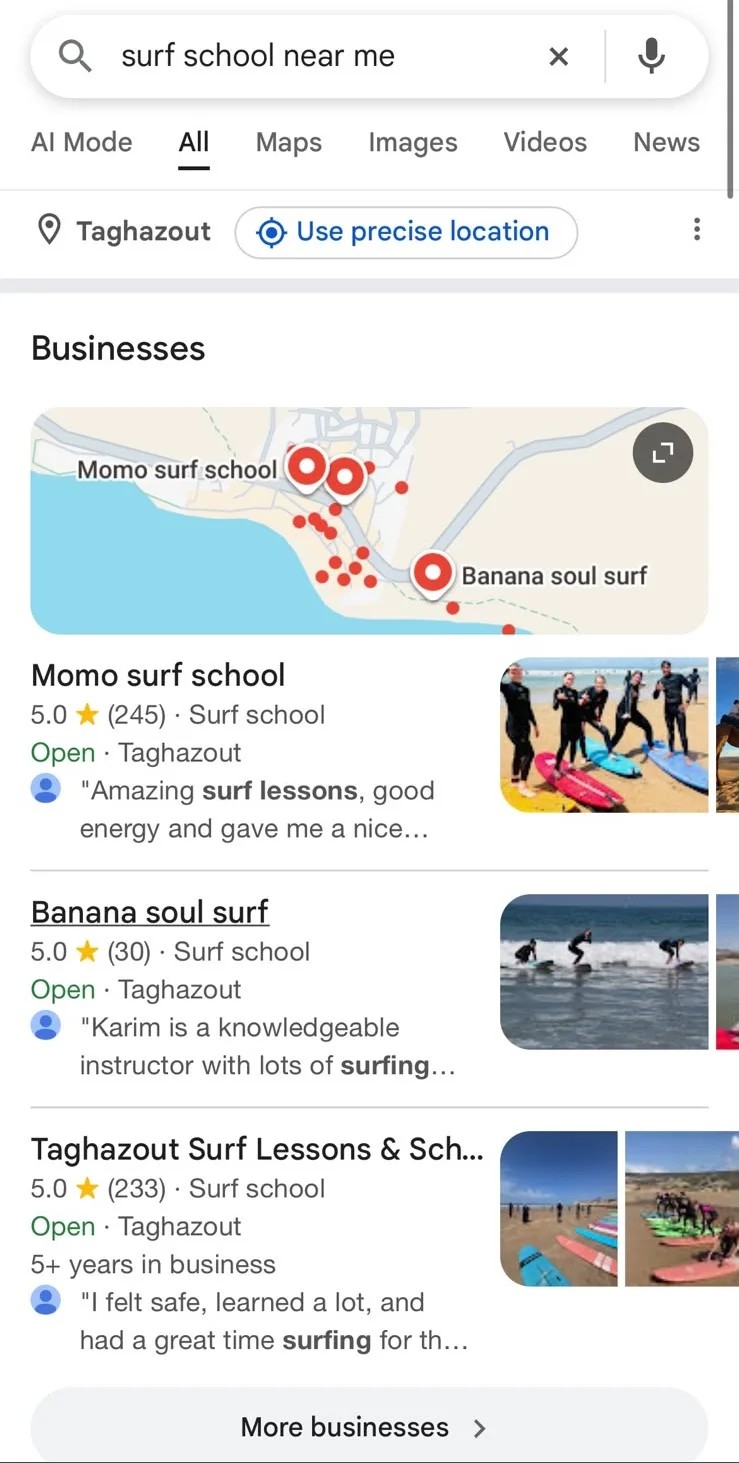
Those three slots are the Map Pack, sometimes called the local pack or the 3-pack. They sit above the ordinary results, they carry a phone number and directions, and on a phone they can fill the entire first screen.
Local SEO is the work of getting into those three. Everything else is secondary, and the 3-pack has its own quirks worth understanding.
Why local SEO is a different job from normal SEO
Ordinary SEO is about a page. Local SEO is about a place.
Ordinary SEO asks whether your page deserves to rank for a phrase. That is decided largely by your website: what it says, who links to it, how fast it loads. The same page ranks roughly the same for everybody who searches.
Local SEO asks whether your business deserves to be shown to somebody standing where they are standing. That is decided mostly by your Google Business Profile, and the answer changes depending on where the searcher is. Two people a mile apart, typing the same words at the same moment, get different results.
This is the single most important thing to understand, because it makes the obvious way of checking your rank useless. Searching for yourself from inside your own shop is the one place on earth guaranteed to flatter you. That is why serious rank checking uses a grid of points across a town rather than one search, which is what our free Google Maps rank checker does.
What Google is actually weighing
Google names three factors for local results: relevance, distance and prominence. They are not equal, and only some of it is yours to change.
Relevance is whether you do the thing that was searched for. Google reads your primary category first and hardest, then your services, then your description. A surf school listed under the generic "sports club" is competing for the wrong searches, and no amount of reviews fixes that.
Distance is how far the searcher is from you. You cannot change it, and you should stop trying. What you can change is how far your visibility reaches before it fades, which is a function of the other two.
Prominence is how well known and well regarded the business appears to be. Reviews are the loudest part of it, and how recent they are matters as much as how many. Activity on the profile counts. Being mentioned consistently on other trusted sites counts.
The practical read: two of the three are yours, so spend your effort there and stop worrying about the one that is not.
Your website matters less than you think
This is the part owners find hardest to accept, especially after paying for a site.
Your website is one input into prominence. It is not where the map results come from. The map reads your Google Business Profile: your categories, hours, services, photos, reviews and posts. You can rank in the top three with a modest website and a well-run profile, and you can have a beautiful website and be invisible on the map.
What actually moves the needle
In rough order of return for effort spent:
- Your primary category. The single highest-leverage field on the whole profile, and the one most often set wrong. Pick the most specific category that describes what you do, not the broadest.
- Reviews, and recent ones. A steady trickle beats a big old pile. Ask at the moment of relief, when the job is done and the customer is pleased, not weeks later by email.
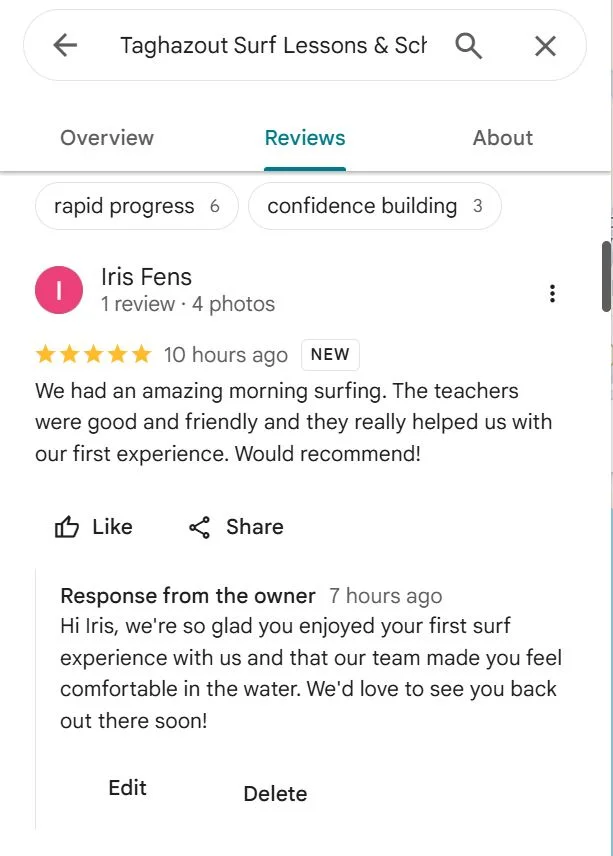
- Replying to every review. Including the good ones. It is a visible activity signal and it is read by every future customer.
- Completing the profile. Services listed individually, hours including holidays, a description that says what you do and where, in the first sentence.
- Photos, regularly. Not one bulk upload. A few every couple of weeks.
- Posts. The least glamorous item here and one of the most neglected. It keeps the profile reading as a live business.
- Consistent listings elsewhere. Your name, address and phone identical everywhere they appear. Two spellings look like two businesses.
Notice that none of the first six involve your website. The full checklist covers how to do each properly.
How long it takes
Longer than a paid ad and shorter than most people fear. Profile changes such as a corrected category can show within days. Reviews and activity compound over weeks. A business starting from a neglected profile in a normal market usually sees real movement in one to three months, and competitive city-centre categories take longer.
The honest version: it is slow at first and then it is durable, which is the opposite shape to advertising. More on the timeline.
The mistakes that cost the most
- Checking your rank from your own address. It flatters you, every time. Check from across town.
- Stuffing keywords into your business name. Against Google's rules, reportable by competitors, and a suspension risk. It also works less well than people think.
- Buying reviews. Detectable, removable, and a fast route to losing the profile entirely.
- Choosing a broad category to catch more searches. It does the opposite. Specific categories match more of what people actually type.
- Treating it as a project. A profile optimised once and left alone decays, because your competitors do not stop.
Where to start this week
If you do nothing else, do these four:
- Check your primary category, and make it more specific if it is generic.
- Reply to every review you have, including the old ones.
- Ask three recent happy customers for a review.
- Check where you actually rank from across town, not from your desk.
That is a morning's work and it is more than most of your competitors have done. If you want a scored starting point, the free profile grader gives you a number out of 100 and the specific gaps behind it.
Common questions
What is local SEO in simple terms?
It is the work of getting your business shown to people searching nearby, in the map results at the top of Google. It is mostly done on your Google Business Profile rather than your website.
Is local SEO different from SEO?
Yes, and the difference is what gets ranked. Ordinary SEO ranks a page, judged largely on your website. Local SEO ranks a business, judged largely on your Google Business Profile, and the result changes depending on where the searcher is standing.
Do I need a website for local SEO?
You can rank in the map results without one, and plenty of businesses do. A website helps: it confirms what you do, gives Google and the AI assistants something to read, and is where people go to check you are real. But it is a supporting signal, not the deciding one.
How much does local SEO cost?
The work itself is free if you do it yourself, and it is genuinely doable: the highest-leverage items are a category, some reviews and a complete profile. Agencies charge monthly to do it for you, and tools sit in between. What local SEO actually costs breaks the options down.
Can I do local SEO myself?
Yes, and for a single location it is usually the better choice. The work is not technical. It is a category decision, a review habit, and a profile kept complete and active. What people struggle with is not difficulty but consistency, which is exactly what nobody tells you when they sell you a package.
How do I know if it is working?
Track the share of points across your area where you appear in the top three, and watch it monthly. Not your best position, and not an average, because both hide a decline. If you are only ever checking from one place, you are not measuring anything.
Does local SEO still matter now AI answers questions?
More, if anything. Assistants answering "who should I use near me" read the same public signals: your categories, your services, your reviews and how consistently you are described across the web. A profile built to rank on Maps is also a profile built to be recommended by an AI, which is why the two jobs have converged rather than split.
See where you stand, free
Run your business through the free Google Business Profile Grader for an instant 0-100 score, or check your map rank with the Local Rank Checker. Want a playbook for your specific trade? See our local SEO guides by industry, or start free with RankLocal and let it fix everything automatically.